


Modern device for systems monitoring
Virtus is a modern and advanced device that allows remote supervision of various environmental parameters. With support for various sensors and a wide array of power supply methods, Virtus is ideal for use in offices, warehouses, production halls and in data centers.
Supported communication protocols
Virtus offers extensive communication capabilities, making it easy to integrate with existing monitoring and automation systems. The device supports popular protocols such as Modbus TCP, Modbus RTU, SNMP, and HTTP/HTTPS. This versatility facilitates communication with other devices and monitoring platfroms. Virtus also supports the MQTT protocol, ideal for IoT applications, enabling secure and fast real-time data transfer. With this set of protocols, Virtus can easily integrate with many management and supervision systems. It is a flexible solution suitable for both small and large installations.
Sensors
Environmental sensors connect to the device via a 3-wire bus in the form of an RJ12 flat or three-wire cable, which supports up to 32 sensors. To facilitate installation, sensors have an additional connector for connecting another sensor.
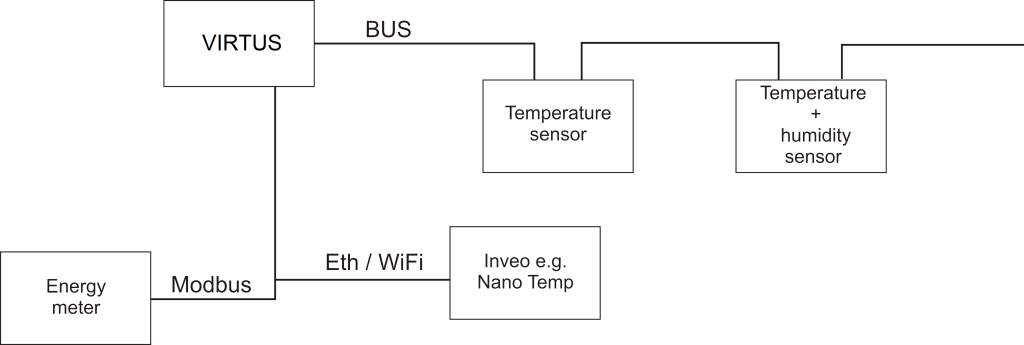
The device supports the following sensors:
- Temperature,
- Humidity,
- Water leakage,
- Phase loss/power outage,
- Light intensity,
- Air pressure,
- Water pressure,
- CO/CO₂/NOₓ gases,
- Door opening (reed switch),
- Others upon special order.
One sensor can handle multiple measurement components. The device stores sensor data in its built-in memory, allowing for later review. Users can download data in various formats. For convenience, data can be visualized using graphs. Each sensor can have thresholds set, after which the device will perform a specific action (Action).
Actions
An action can be triggered, for example, when the temperature exceeds a threshold, when an input changes, or when a connection is lost. Each event can have a different Action assigned or share an Action among several events. An Action can include the following actions (one or more):
- Control of an output,
- Sending an HTTP request,
- Sending an Email,
- Sending an SNMP Trap,
- Sending an SMS,
- Sending an MQTT message,
- Sending data via UDP/TCP,
- Sending a KNX message,
- Saving to an internal variable,
- Logging data to memory.
Actions can be triggered once—for example, when an input changes or during set time intervals. For example, after the temperature exceeds a threshold, send an email after 1 minute and repeat the sending 6 more times every 10 minutes.
Inputs
Each input is equipped with a pulse counter, noise filter, and state inversion capability. Built-in algorithms allow for many useful functions, such as:
- Simple on-off dependencies
- Long press detection, allowing one button to control 2 actions
- Counting activations, triggering the appropriate function (up to 4 different functions) after a specified time—enabling control from one button to up to 4 separate circuits/devices
- Comparing pulse frequencies to a set value and executing the appropriate action on change
- Standard counting of pulses on input and, for example, sending this data to a server.
Outputs
The device’s outputs can operate in the following modes:
- Bistable – on/off,
- Astable – continuous alternating on/off at specified intervals,
- Timed – activation of the input activates it for a specified time.
Power supply
The device can be powered via PoE 802.3af, in addition to DC: 10-24V DC and 48V DC for use with reserve power batteries in telecommunication systems, making it resilient to power outages, guaranteeing constant monitoring in every situation.
Logic Module
Users can connect any logical functions with various states of the device, such as input state, output state, sensor state, and variables. Based on the obtained result, users can then control outputs or trigger appropriate actions. This flexibility allows for creating complex scenarios tailored to needs, significantly enhancing the device’s functionality. For advanced users, a LUA interpreter has been developed, enabling unlimited control over device functions.
Integration with Inveo devices
The module recognizes other Inveo devices on the network and allows access to them from the device level (integrator). This enables, for example, configuring a temperature sensor that retrieves data from a remote point or connecting an input or output to a remote device. The device is compatible with Daxi, Nano, Hero, Lantick, and Iqio modules.
Applications
Thanks to its versatility, Virtus suits a wide range of industries and sectors. It can be used for monitoring of environmental conditions in manufacturing, where precise parameter monitoring is crucial for production quality. Additionally, Virtus is ideal for warehouses. It maintains appropriate temperature and humidity levels for stored goods.
The device is housed in a 1U metal enclosure, designed to mount inside a network rack cabinet.
Why choose Virtus?
Virtus combines modern technology with ease of use, making it an ideal solution for both small and large companies. Thanks to its flexibility and scalability, Virtus can grow with your business’s needs, providing reliable monitoring and automation at every stage of operations.